

The application I
submitted seeking registration for MA degree program at the Department of
English Studies in the UNISA was accepted and I was informed to submit a
statement of intent. To gain an understanding about conducting research
studies, I consulted a number of books and journal articles. Among the books, I
found the following list very useful and comprehensive. Anyone wishing to
conduct an empirical study in the field of SLA should consult these books to
gain a better understanding about the filed.
Brown, J.D.
1988. Understanding research in second language learning. Cambridge:
Cambridge University Press.This text is most concerned with quantitative methods and statistics.
Brumfit, C.
& Mitchell, R. eds. 1989. Research in the language classroom.
London: Macmillan.
In this book a
variety of methods of classroom research are discussed.
Dörnyei, Z.
2007. Research methods in applied linguistics. Oxford: Oxford University
Press.
Although the
field here is applied linguistics this source is particularly relevant and
helpful with regard to mixed method research (combining quantitative and
qualitative approaches).
Hofstee, E.
2006. Constructing a good dissertation. Sandton: EPE.
This is a
general but very readable guide to doing research at higher degree level.
Leedy, P.D. 2001.
Practical research: planning and design. New York: Macmillan.
Although this book focuses on qualitative and quantitative methodology in the humanities in general rather than specifically in linguistics or applied linguistics, it does devote a whole chapter to the question, ‘research methodology: qualitative or quantitative?’, and then four further chapters deal more specifically with these methodologies.
Litosseliti, L. (ed.) 2010. Research
methods in linguistics. London: Continuum.
This book contains some very
up-to-date and practice-oriented chapters on quantitative, qualitative and
mixed methods research as well as on corpus linguistic, discourse analytic and
ethnographic approaches.
Mouton, J. 2001. How to succeed
in your master's and doctoral studies: a South African guide
and resource
book.
Pretoria: Van Schaik.
This is a good general text with
a local perspective, and it includes examples of successful and less successful
attempts by students to complete the sort of tasks that research degree study
requires.
Nunan, D. 1992. Research
methods in language learning. Cambridge: Cambridge University
Press.A very good source with an applied linguistics focus.
Nunan, D., & Bailey,
K. M. (2009). Exploring Second Language Classroom Research: A Comprehensive Guide. Heinle. USA.
This is one of the latest book
that deals with both qualitative and quantitative research methodologies with
specific reference to classroom research.
Seliger, H.W. & Shohamy, E.
1989. Second language research methods. Oxford: Oxford
University Press.This is a good source for discussion of a number of different research approaches.
Wray, A., Trott, K. &
Bloomer, A. 1998. Projects in linguistics. London: Arnold.
A wide-ranging introduction to
research in linguistics.
The following texts will help you
deepen your understanding of aspects of quantitative methodology:
Butler, C. 1985. Statistics in
linguistics. Oxford: Basil Blackwell.Mulder, J.C. 1986. Statistical techniques in education. Pretoria: HAUM.
Woods, A., Fletcher, P. & Hughes, A. 1986. Statistics in language studies. Cambridge: Cambridge University Press.
Mackey, A. & Gass, S.M. 2005 Second language research: methodology and design. Mahwah,
N.J.: Lawrence Erlbaum.
There is a very short section on the literature review in Chapter 10.
McDonough, J.
& McDonough, S. 1997. Research methods for English language teachers.
London: Arnold.This one is also more about methods than topic areas, but it does contain quite a few references to research on certain topics.
(DLINALL (DPCHS02/DIS8273/TFLIN05/DISDTSP/TFTLS05)
Tutorial Letter 301/2013, Research proposal module/Thesis, Department of Linguistics, UNISA)
After
reading some of the texts stated above, I was able to gain a better
understanding about the basic concepts in carrying out a research in classroom context.
As we already know reading plays a crucial role in one’s academic life. Therefore,
when we engage in any kind of studies, we should never keep distant from
prescribed texts and journals. As noted above, after reading some of the texts
and journals, I became interested in conducting an empirical study to
investigate the effects of authentic materials and contextually-developed
role-playing activities on oral proficiency of my undergraduate students. My
research problem emerged as I was teaching English communication course to
undergraduate students at Prince of Songkla University.
The English conversation course I taught included two oral tests; one in the
middle of the semester and the other at the end of the course. These two tests
account for 40% of the final mark. When I conducted these tests, I found that
most of my students did not speak well enough to be considered as proficient
users in the target language. It should be noted here that these students who
are non-English major undergraduates have studied English as a subject at
school for almost ten years and that they have already studied the Foundation
English course because this is one of the compulsory subjects in their first
year. Foundation English course is offered by the Department of Languages and
Linguistics and its main focus is on the development of the four major language
skills.
Lack of oral proficiency in the target
langue constantly poses problems for my students both in academic and social
contexts. Most of my students who are undergraduates from different majors such
as Marketing, Engineering, Computer Studies, Nursing, and Community Studies
aspire to find a job after their graduation while a few chooses to pursue their
higher studies in a foreign university. For both these situations stated above,
they need to achieve oral proficiency in the target language. Therefore, given
the problem described above, my study revolved around the research problem what
can be done to help my students achieve oral proficiency in the target
language.
The participant I selected for my study were very
cooperative and showed interest in participating classroom activities I did to
gather data for analysis. I video-recorded
most of the students’ activities when they were performing in the class.
The following photos show students’ oral activities.
Students make phone calls to reserve a room in a hotel


Students use a map to give directions

Students engage in a conversation

Students use authentic materials for a communicative activity

Students use a PowerPoint presentation

Students interaction
The study lasted for one semester and I was able to complete
writing the final report in time. My supervisor was very helpful and constructive
in providing me with required guidance and feedback. Her work and dedication
should highly be appreciated and valued because I really know that doing an
experimental study is rather difficult. At the very beginning, she encouraged
me to do a study that would at least help the participants who were selected. She
was on the opinion that I should not write a thesis which would stay in a
bookshelf in a library with no human touch. This idea struck my mind so deeply
that I determined to do an experimental study rather than a qualitative. Even
though there were intervening variables, I conducted the study successfully and
wrote my final report and submitted for the higher degree committee of the
UNISA for evaluation. My thesis was examined by two examiners; one internal and
the other external. At the end of their evaluation, I received the both
examiners comments in which they had mentioned both good and weak points
present in my study.
 My supervisor, Ms Thuli Shandu, MA (Monterrey Institute)

When I first enrolled for the BA (Honors) degree at the department of English Studies at UNISA in 2010, Professor Brenda Spencer was the Course Coordinator for TESOL at the department and she was my lecturer for the Module-Literature in TESOL. She was not only very pleased with my assignments but also encouraged me to pursue my post graduate studies in TESOL. Her contribution to widen the vistas of my insightful understanding in TESOL eventually helped me earned my master’s degree with 70 marks out of 100 in 2012. Together with the comments of the two examiners, I was informed of the results of my thesis which stated that I had passed the examination. However, I was happy with my results. My supervisor, Ms. Thuli Shandu sent me an email saying that all of my hard work that I did during my study had ultimately paid off.

Given below is the statement of results of my MA degree
Abstract of my MA thesis
ABSTRACT
THE
EFFECTS OF AUTHENTIC MATERIALS USING ROLE-PLAYING
ACTIVITIES
ON ORAL PROFICIENCY: A CASE STUDY OF THAI
UNDERGRADUATE
STUDENTS
BY: SARATH WITHANARACHCHI SAMARANAYAKE
Degree: Master of Arts with Specialization in TESOL (Teaching
English to Speakers of Other Languages)
Supervisor: Mrs. T. P. Shandu
Abstract
This
study investigates the effects of authentic materials and
contextually-developed role-playing activities on the oral proficiency of Thai
undergraduate students. The study was conducted at Prince of Songkla
University, Thailand during the first semester (June to September) of 2010. The
study consisted of four research instruments and the data were analyzed using
Independent Samples t-test to determine whether the authentic materials and contextually-developed
role-playing activities had improved the students’ oral fluency and accuracy in
the target language. The findings indicated statistically significant
differences between the two groups wherein the experimental group performed
better on both fluency and accuracy than the control group. Therefore, based on
the findings of the current study, it can be concluded that authentic materials
and contextually-developed role-playing activities involving a series of
sequential events are effective in enhancing learners’ oral proficiency in programs of English as a foreign language
in the context of Thailand English education.
There were many academics who helped me complete my MA degree. Among them, Ms. Rungrat Charoenwisal (M.ED) Research and Evaluation is worth mentioning here since her contribution as a statistician to my study was greatly helpful. She willingly undertook to perform all statistical calculations needed for my research and it was found to be superb in quality and accuracy. So a special thank should go to her. She is a social worker and spends her time helping her community to bring its literacy rate to a higher level. Her work includes conducting work shops, helping undergraduate and graduate students to do research. In addition, She organizes and performs religious activities. She is based in Hatyai, Songkla, Thailand where she runs an educational institutes called "Happy Time Learning".

Ms Rungrat Charoenwisal (M.ED) Research and Evaluation
My MA thesis was published as a book by Lambert Academic Publishing Company in Germany.


My MA thesis was published as a book by Lambert Academic Publishing Company in Germany.


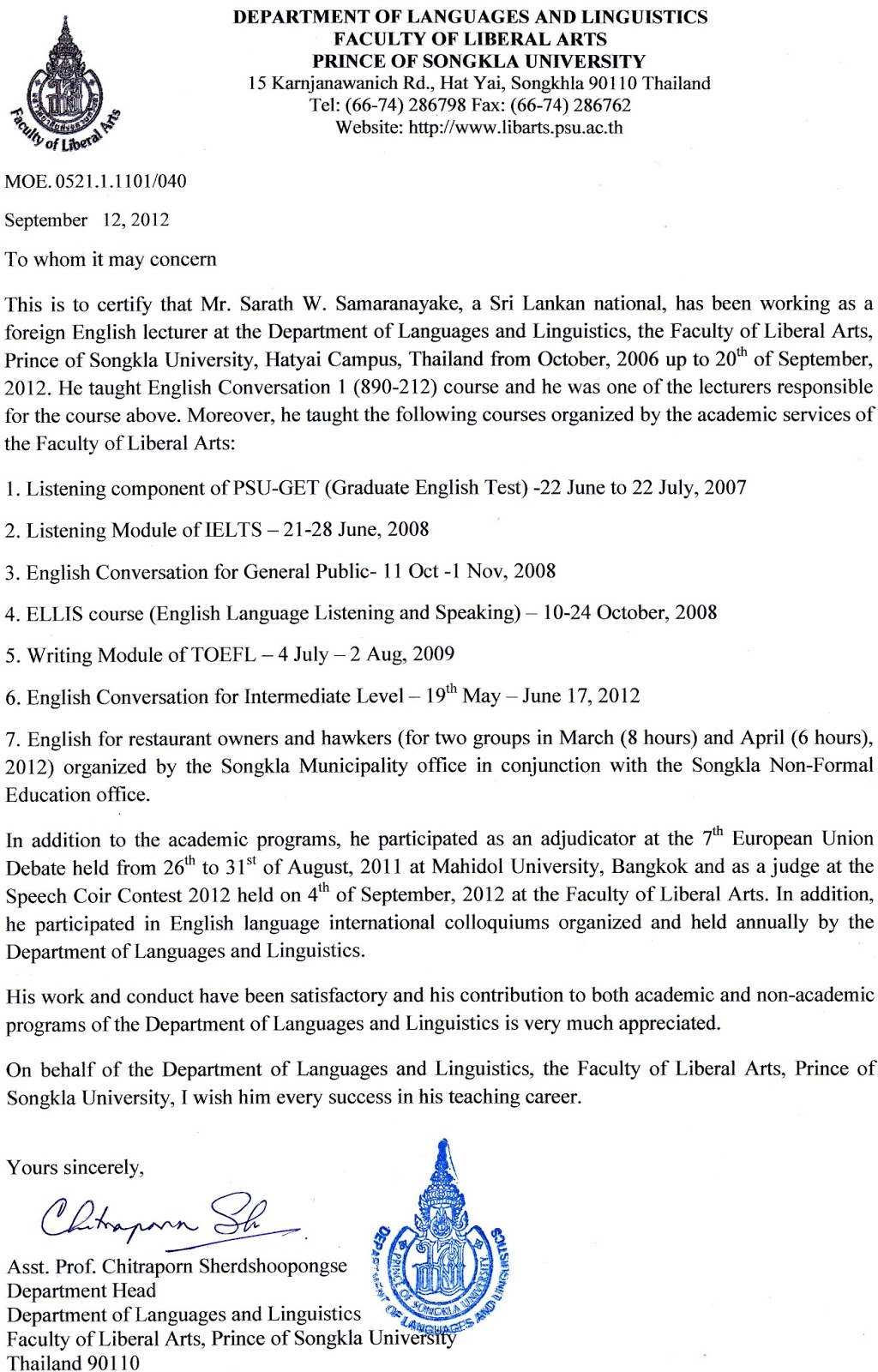
A job offer in Oman
Oman is an absolute monarchy.The Sultan Qaboos bin Said al Said has been the hereditary leader of the country since 1970. Sultan Qaboos is the longest-serving current ruler in the Middle East, and seventh-longest current-reigning monarch in the world (https://en.wikipedia.org/wiki/Oman)
The photos which are given below will remain as living evidence of Oman's beauty.


A mosque


After completing my MA in TESOL degree, my next target was to move to a Gulf county where expatriate teachers are paid relatively well compared to the other countries in the world. Even though I stayed in Thailand for six years, saving money became difficult since I had to spend a considerable amount of money for family expenses which included house rent, school fees and other expenses. My family did not move to Thailand since my wife is employed in the government sector while my son was schooling in Sri Lanka. However, they visited me every year so that a some amount of money had to be spent for travelling. The salaries paid for university foreign lecturers are not high in Thailand. However, if you do not have a lot of expenses, the salary will be quite enough because goods and services are not very expensive there.
As noted earlier, I began my job hunting using websites and I found a big number of job offers in the education sector in the Gulf region. I had a predilection for Oman because one of my friends whom I met while I was teaching in the Maldives, told me that Oman is a better country to work as people are specially friendly and mild tempered. In 1980s, there was a good demand for Sri Lankan teachers in Oman. Then, Omani officials came to Sri Lanka to select teachers to work in their schools and later that practice was no more in function. Instead, they began to look for native speakers to fill the English teaching vacancies in schools and other education institutes as other Gulf countries did and are still doing. Therefore, it has become quite hard to get a teaching position in Oman nowadays.
While searching
for a suitable position in the education sector, I found an Omani company which
recruits English lecturers for colleges of technology which come under the
purview of the Ministry of Manpower in Oman. However, in the advertisement, it
was mentioned all information about the position advertised including what kind
of nationalities (UK, USA, New Zealand, Australia and South Africa) they were
looking for to fill in the job positions. Even though, I was not a native
speaker of English from any of the countries listed above, I determined to send
an application for the position of an English lecturer and waited with no
hopes. After two months, I received an email from the company to which I sent
my application which stated that they would consider my application and would
offer me the job provided that I got through the interview which they would
arrange me in consultation with the college of technology where the vacancy
exited. I replied expressing my consent to be interviewed by the specific
college of technology at a particular date and time they would arrange. Meanwhile,
I continued my work at the university as usual without informing them anything
about my decision. After a week of this, I was sent another email informing of
the telephonic interview schedule and it was scheduled to hold on a week day
around 1 p.m. Fortunately, that day I did not have any work in the afternoon so
I was free and looking forward to the interview. The table clock placed on my
table indicated 1p.m local time (Thailand) and there was no call from the
college or from the H.R. assistant from the company. I got nervous but waited
expecting that any moment my phone would ring. As is always the case with time,
it continued to pass and now the time was 1.20, but no call was there. I kept
on sitting at my table thinking that my phone would ring now………However, around
1.25, my phone rang and I with full of excitement, lifted the receiver and
placed it on my left ear holding it firmly from my left hand. H.R. assistant
from the company called and told me that he was going to connect me to the
college authorities for the interview and asked me to hang on. After a few
seconds, a voice sounded and introduced who he was and asked to tell something
about myself. I told him briefly about me and my current work and work
experience I have had as an English teacher. After my description, he thanked
and asked me to remain connected as there was another interviewer. After a few
seconds, another official spoke to me but his voice was unrecognisable so I
asked him to repeat what he had said. He repeated the question, “Can you briefly
explain the procedure how you will present a writing activity to beginner level
EFL students?’ and then it was clear for me to answer his question. I explained
to him the steps in presenting a writing activity to EFL learners. I expected
him to ask a more difficult question but the question he asked was not very
difficult to answer as we are used to teaching all skills to EFL/ESL learners
in our career. The interview was conducted as the way described above and I waited for the results of the interview. One month after the interview, I received the following letter which offered me a position as an English Lecturer at Shinas College of Technology. Information relevant to salary has been removed from the the appointment letter for ethical reasons.


Arriving in Oman


Arriving in Oman
Travel arrangements to
Oman were done by the company and my visa and air ticket were sent to me
through my email indicating that I should arrive on 2nd of November,
2012. I left Prince of Songkla University on 24th of August, 2012
and I had to wait for nearly two months at home with no work. However, on the
second of November, I left Sri Lanka in an Oman air flight. My flight left Sri
Lanka at 7.20p.m and the journey took 3 hours and 30 minutes from Bandaranayake
International Airport to Seeb International airport in Oman. When I got down
from the plan, it was about 9.10p.m which was one hour and thirty minutes ahead
of Sri Lanka’s local time. Even though I have had travel experience, I was a
little bit nervous since it was my first travel to a Gulf country. Having
disembarked at Seeb international airport and gone through the immigration
formalities, I came out of the arrival lounge to see if anyone from my company
had already arrived there to receive me. While coming out of the arrival door,
I noticed many people holding name boards in their hands eagerly looking for
their visitors. I read them all but could not find anyone holding my name so I got confused why there
was no one from the company there. I
kept on proceeding searching for someone who may have come from my company to
receive me. Time continued to pass suddenly I heard a conversation of three
passengers who were also waiting there outside the arrival lobby waiting for
someone from the company to come.

Entrance to Bandaranayke International Airport, Sri
Lanka

Inside view of Bandaranayake Airport. Photo credit to
Balou46 - Own work, CC BY-SA 3.0, Retrieved from https://commons.wikimedia.org/w/index.php?curid=31132938

Angle view of Bandaranayake Airport. Photo credit to
Saqib Qayyum-Own work, CCBY-SA 3.0. Retrieved from https://commons.wikimedia.org/w/index.php?curid=11440990

Interior view of Bandaranayake Airport. Photo credit
to Cherubino - Own work, CC BY-SA 3.0, Retrieved from https://commons.wikimedia.org/w/index.php?curid=30070307

Arial view of Bandaranayake Airport- Photo credit to
the Dilubaba (talk) - Own work (Original text: I (Dilubaba (talk)) created this
work entirely by myself.), Public Domain, Retrieved from https://commons.wikimedia.org/w/index.php?curid=13087433

Muscat International Airport. Retrieved from http://www.flightswatcher.com/muscat-international-airport-reviews/

Recent changes made to
Muscat International Airport has intensified its significance and beauty as an
international airport. Interior view of Muscat Airport. Retrieved from
They
were talking about the same issue I had, so I got close to them and introduced
myself and told them that I was also waiting for someone to come from the same
company. They were also newly recruited lecturers from India for the Colleges
of Technology in Oman by Globnet Company. As they arrived at the airport before
me, they had been able to contact the company and informed me that someone from
the company would come to the airport to fetch us within the next 30 minutes. I
breathed a sigh of relief on hearing that and meeting those lecturers at such a
crucial time when I began to feel a sense of insecurity in a foreign land. However,
it should be mentioned that 30 minutes became longer and finally a person came
to us where were waiting and apologized for his delay. He introduced himself to
us as one of the Personal Relations Officers (PRO) from the company. The company
had already arranged our accommodations in hotels or guest houses so we were
taken to our respective places in two cars because there were six of us
altogether. I was taken to a guest house which looked like a flat with two or
three floors. The only instruction the person who took me there gave was to be
ready by 8 a.m., the following day. The apartment comprised of two big rooms
with a kitchen and a living area. The kitchen included an electric kettle, a
fridge, a microwave oven and some crockeries. There were some stuffs like milk
powder and tea bags. I began to feel hungry because the food I was offered in
the plan had already digested. I first thought of going out and find a
restaurant where I could have my dinner but the problem was I did not know anything
about the vicinity of the place I was staying. A closer look from the window of
my bedroom revealed that there was no sign of a restaurant or a hotel nearby so
I decided to satisfy my hunger through a coffee. Thus, I made a coffee and
drank and then went to bed remembering a similar incident I faced when I went
to the Maldives in 1991 to take up a teaching position there. Luckily that day
I went to the Maldives during the daytime. When I reached the arrival door,
there was a person to receive me and he took me to Male, the capital of the
Maldives by a boat. He left me in a guest house and gave me some money
(Maldivian Rufiyaa) and told me that he would come to take me to the education center
the next morning. I was feeling hungry and thinking about finding a hotel or a
restaurant there to eat something. I talked to the lady who was the owner of
the guest house and inquired about a place where I could eat food. She informed
me that the guest house would provide me with breakfast only and other two
meals I should eat out. Now the time was around 1.30.p.m. and it was during the
Ramadan festival where Muslims abstain taking food during the day time (fasting
period). She told me that all restaurants are kept closed and they will reopen
after the evening prayer which will be around 6.p.m. No alternative left for me
but I had taken some sweets from home and it saved me from hunger temporarily but
waited patiently for the restaurants to open.
As
noted above, now I was experiencing a similar situation in Oman. However, I
slept with an empty stomach until the next morning. I got readied and waited
for the same person to come to take me to the company’s office around 8.a.m. No
one came at 8.a.m. From this incident and the last where the PRO was not punctual,
I figured out that these people are not time-minded and do not work according
to the time even though they say they do. As there was no any mode of
communication available for me, I could not call anyone but to wait until they
come. Around 10.a.m. someone knocked on my door and said that someone had come
to pick me. I took my luggage and went down to see the PRO but it was not the
same person who took me last night. There was an Omani lady in the car and when
I approached it, she herself introduced and told me that their PRO was absent
today so she came to take me to the office. So, I said “Ok” and got into her
car which took me to the office in 10 minutes. When I went there, I found all
the other lecturers whom I met the night before had arrived and they were
waiting to sign the contract documents. It took nearly two hours to complete
all paper work including medical test. Later, we were informed that we would be
sent to our respective colleges the same day afternoon so that we would be able
to report to the duty at the college on the following day.
